

9 Grammar Rules for Perfect Business English
By Business Excellence | Comments: 0 | July 3, 2026How to learn English grammar? What are the main grammar rules? How to acquire useful phrases and sound like a native speaker? Yes, these are all questions asked by those who want to improve their English language skills.
Below you can read some tips and grammar rules that will help you make a good impression on others.
Rule No. 1
Use a timeline to learn English tenses. This is an excellent answer to the question of how to learn English grammar. A timeline is a method of visualizing how actions take place.
These are some general English grammar rules that you can now reinforce using a timeline.
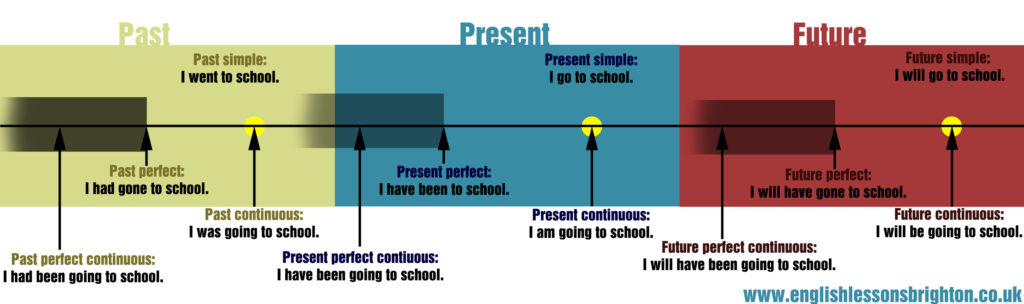
Present Perfect Tense
Use the Present Perfect tense for actions that started in the past and are connected to the present (they started recently or have an impact on the present). When deciding which tense to use, think about whether the action is connected to the present. If not, then it is Past Tense:
Our competitors have lowered their prices so we’ll have to do the same.
I have never seen such an impressive resume. (The action has just finished. We can also add “until now” to indicate Present Perfect usage.)
Past Tense
The statement was released and then we got several questions from shareholders.
Past Perfect Tense
The Past Perfect tense is used for actions that happened before another past moment. When using perfect tenses, pay attention to whether one action happened before another.
By the time I handed in my resignation, I had already been contacted by two different headhunters.
Future Perfect Tense
The Future Perfect tense is used to describe an action completed before a specific point in the future.
I will have finished the report by the time you give me the email address.
Continuous Tenses (Present, Past, Future)
Continuous tenses are used for actions in progress, when the speaker emphasizes duration or ongoing activity.
Present Continuous: They are going through a complex restructuring process so I don’t know if they have any job openings.
Past Continuous: I was interviewing the second candidate when I got your text message.
Future Continuous: In my presentation I will be talking about new market research methods.
It is important to distinguish between “What do you do?” (your job) and “What are you doing?” (now), which is a common mistake in English:
“What do you do?” – What is your profession?
“What are you doing?” – What are you doing right now?
Rule No. 2
When you learn a new rule, use it in your own example sentences. Repeat each new word 15 times in written and spoken form.
Rule No. 3
Passive voice is used when you want to emphasize the action rather than the person performing it. English often prefers passive voice because it focuses on results rather than the doer of the action. It is also useful when describing problems without assigning blame. Passive voice is more formal and professional.
Passive voice is formed using the verb “to be” and the past participle (third form of the verb). The agent can be added at the end if needed.
The meeting will probably be delayed (by the chairperson).
The report was sent to the wrong recipient.
The email hasn’t been sent yet because of technical problems.
It is recommended that we do more research before launching the product.
It has been suggested that better teamwork will lead to better results.
Rule No. 4
Modal verbs such as may, might, can, could, shall, should, will, and would are the secret ingredient of a good speaker. Modal verbs add meaning to the main verb and are often used to sound more polite in formal situations.
Arranging a Meeting
Could we meet at _____?
I can meet at _____. / I can’t meet at _____.
Should I reserve the conference room?
Might we discuss it over lunch?
The meeting should take about 30 minutes.
Conducting an Online Meeting
Could you please mute your microphone when you’re not speaking?
Can everyone hear/see me?
Before we begin, we should each introduce ourselves.
Giving a Presentation
Might/may I have your attention, please?
Could you please save your questions until the end?
Today, I would like to discuss…
In conclusion, we must find a way to decrease costs, increase profits, or find our niche.
Speaking to Your Colleagues
I might attend the conference. What about you?
I could use a day off. What about you?
Can/Could I give you some advice?
Can/Could I ask you a favor?
Speaking with a Client or Customer
We would like to set up a face-to-face meeting.
May I offer you…?
It would be my pleasure to…
I might be able to…
Would you like to renew your account/subscription?
Could you give us a list of your requirements?
Taking a Phone Call
Could I ask who’s calling, please?
How may I help you?
Can I take a message?
Should I call back later?
Could you repeat that?
Hiring an Employee
Can/Could you tell me more about your work experience?
You must arrive on time for the interview.
You should submit three references with your application.
Rule No. 5
Conditional sentences consist of two parts: the if-clause and the main clause. There are three types of conditionals.
Type 1
Used for real situations in the present or future.
Formula: If + present simple, will/won’t + verb
If he sends you the report, make sure you let me know.
Type 2
Used for unreal present situations.
Formula: If + past simple, would/wouldn’t + verb
If he were hired, I would be his colleague.
If they raised everyone’s salaries, we would be the first to find out.
Type 3
Used for unreal past situations.
Formula: If + past perfect, would/wouldn’t have + past participle
If he had been my supervisor, I would have told him why I couldn’t reach my target.
If you had told me about the meeting, I would have come.
Rule No. 6
The definite article “the” and the indefinite article “a/an” are often difficult for non-native speakers.
“The” is used when we refer to something specific:
I received the email that you mentioned during the meeting.
I don’t like emails that don’t have a subject line.
“A/an” is used when we refer to something general or unknown:
I need a pencil.
I am an architect.
Rule No. 7
Who vs Whom
Who refers to the subject of the sentence: He’s the executive who negotiated the deal.
Whom refers to the object of the sentence: She’s the client to whom I was speaking.
Rule No. 8
Then or Than
Then refers to time: We should send out the email, then wait for their responses.
Than is used for comparison: I would rather extend the meeting than meet tomorrow.
He is taller than me.
Rule No. 9
Read texts and news written by native speakers. Read about topics that interest you in English.
Ready to master English grammar and start speaking with confidence? Contact us at info@be-institute.com and discover how Business Excellence can help you achieve your goals.